


Tips and decision-making aids for choosing an apprenticeship
Questions and answers
How long does the ranger training program last, and can I complete it while working?
You can complete the Ranger training program while working. How long it takes depends on the course format, the class schedule, and your personal learning pace.
When planning, you should keep the following points in mind:
- Classes: In-person sessions and hands-on training sessions
- Self-Study: Time for Learning Assignments and Exam Preparation
- Work and Daily Life: Balancing Your Current Job and Your Personal Commitments
- Exam: Preparation for the Federal Professional Examination
The specific duration and schedule of the modules vary depending on the program. Therefore, be sure to set aside not only class time but also enough time for preparation and follow-up work.
Ask the educational provider to show you the current schedule and the total time commitment before you decide on a course.
What are the requirements for the Ranger training program?
If you want to complete the ranger training program leading to a federal certificate, you must meet certain requirements. These relate to your educational background, your work experience, and the required module certifications.
The following conditions apply for admission to the Federal Professional Examination for “Nature and Environment Specialist (female) / Nature and Environment Specialist (male) with a Federal Certificate, specializing in Ranger”:
- Educational Requirements: You must have a Federal Diploma of Vocational Education and Training (EFZ) or an equivalent qualification.
- Work Experience: You must be able to demonstrate at least five years of work experience. At least one year of that must be relevant work experience.
- Module Completion Requirements: Students must complete the required modules for the Ranger specialization as well as the interdisciplinary modules. Equivalent qualifications may be recognized by the relevant quality assurance commission.
The ranger training program at the Lyss Forest Education Center prepares students for the Federal Professional Examination. The admission requirements for the program itself may differ. If you are already working in nature conservation, environmental protection, or landscape conservation, it’s a good idea to have your professional experience and existing credentials reviewed early on.
You can find the mandatory requirements in the current examination regulations and guidelines issued by OdA Umwelt.
What career opportunities will I have after completing the ranger training program?
With ranger training, you can qualify for jobs in nature conservation, landscape preservation, and environmental protection. The positions that are right for you depend on your work experience and the employers' requirements.
Possible career paths after completing the Ranger training course include:
- Nature Parks and Protected Areas: Assisting visitors and providing information about nature and conservation regulations
- Municipalities and public agencies: play a role in the management and promotion of natural areas
- Environmental Organizations: Supporting Nature and Environmental Education Projects
Visitor Centers and Environmental Education: Organizing Guided Tours, Information Programs, and Events - Nature Conservation Projects: Participate in observations, monitoring, and conservation measures
Not every position includes all of these responsibilities, and the ranger training program does not guarantee a specific job. Additional experience or specialized knowledge can expand your opportunities.
Compare current job listings to find out which employers hire rangers and what requirements they have for applicants.
How much does a ranger earn in Switzerland?
How much you earn as a ranger in Switzerland depends on your education, work experience, job responsibilities, and location. Your level of responsibility and specific duties also affect your potential salary. For this reason, it is not possible to specify a standard salary for all ranger positions.
The following provides helpful guidance:Ranger Salary Calculator from the Swiss Rangers Professional Association. The calculation tool takes into account, among other things, your qualifications, work experience, the canton where you work, and your responsibilities in the areas of supervision, visitor guidance, environmental education, monitoring, and project work.
The salary calculator provides a personalized salary recommendation and a basis for salary and performance reviews. However, the calculated figures are not binding, as positions may differ significantly in terms of duties and responsibilities.
If you're interested in Ranger training or are already working in this field, you can use the calculator to better estimate your potential earning potential.
What are a ranger's daily duties?
Rangers manage natural areas, provide information to visitors, and work to ensure that people can enjoy nature without unnecessarily disturbing sensitive habitats.
Possible assignments following the Rager course include:
- Visitor Information: Answering Questions and Providing Information on Safety Regulations
- Nature Education: Organizing Field Trips, Guided Tours, and Environmental Education Programs
- Visitor Management: Raising Awareness of Sensitive Areas and Promoting Nature-Friendly Behavior
- Nature Conservation: Supporting Conservation Measures and Monitoring Changes in Habitats
- Maintenance and Monitoring: Depending on the position, manage visitor facilities or document nature observations
What a typical workday looks like depends on the employer and the field of work. In a nature park, the focus may be on different tasks than in a municipal protected area or at an environmental organization.
The ranger profession is particularly well-suited for people who enjoy working in nature, understand ecological relationships, and want to share their knowledge with others.
What will I learn during ranger training?
During ranger training, you'll learn how to protect natural areas, provide information to visitors, and raise awareness about responsible environmental stewardship.
Possible learning topics include:
- Ecology and Biodiversity: Understanding Habitats, Animal and Plant Species, and Ecological Relationships
- Visitor Management: Balancing Recreation and Nature Conservation
- Environmental Education: Conveying Knowledge About Nature in an Accessible Way and Designing Guided Tours
- Communication: Engaging in conversations with visitors and resolving conflicts constructively
- Nature Conservation in Practice: Supporting Conservation Measures and Monitoring Changes in Natural Areas
The specific content is based on the current training program and the Ranger specialization. The Ranger training program combines specialized knowledge of nature and the environment with practical skills for interacting with people.
If you enjoy working outdoors and want to share your knowledge at the same time, the ranger training program might be a good fit for you.

 Error found? -
Experiences, evaluations and opinions on training / further education
Haven't found the right training or further education yet? Benefit from educational advice now!
Further training is not only important in order to maintain or increase professional attractiveness, investing in training or further training is still the most efficient way to increase the chances of a pay rise.
The Swiss education system offers a wide range of individual training and further education opportunities - depending on your personal level of education, professional experience and educational goals.
Choosing the right educational offer is not easy for many prospective students.
Which training and further education is the right one for my path?
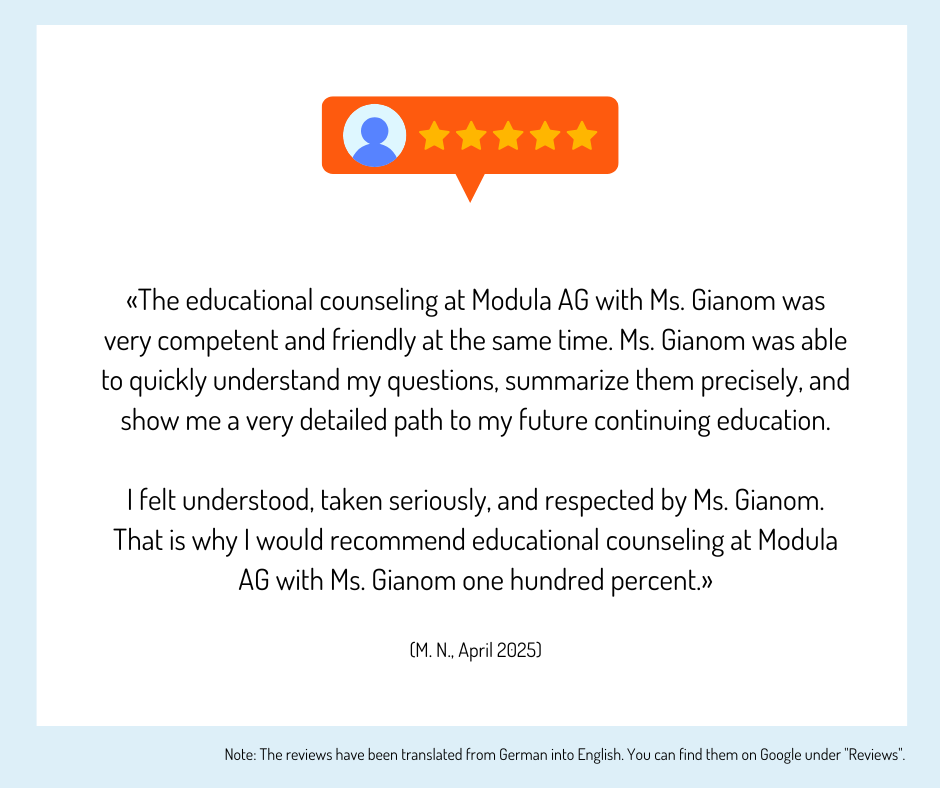
Our education advisory team will guide you through the "education jungle", providing specific input and relevant background information to help you choose the right offer.
Your advantages:
You will receive
- Suggestions for suitable courses, seminars or training programs based on the information you provide in the questionnaire
- An overview of the different levels and types of education
- Information about the Swiss education system
We offer our educational counseling in the following languages on request: French, Italian, English
Register now and concretize your training plans.



Immediately to the right training
Hardernstrasse 20
3250 Lyss

Schools with certified educational counseling